Warm Starts
Over fifteen years of coding, I have sat in open offices, private offices, home desks, and coffee shops. One thing stands out consistently. The engineers who produce the best work are rarely the ones with the fastest laptops or the most monitors. They are the ones who have dialed in their environment.
This is not about interior design. It is about treating your workspace as infrastructure. Your brain is the runtime for your code. If the runtime is cold, fragmented, or uncomfortable, the output suffers. Here is what I have learned about warming it up.
Jumping straight into deep work is like booting a server and expecting it to handle production traffic immediately. A cold start is slow. The brain needs a warmup period. There is a clever way to use the Pomodoro technique for this. Instead of treating 25-minute sprints as the main event, use them as a warmup. Tell yourself you will only code for 25 minutes. No pressure. After two or three of these, the resistance fades. Suddenly a four-hour flow session does not feel like a chore. It feels natural. This is the warm start principle applied to cognition. You cannot force the flow state. You can only create the conditions for it.
Think of how athletes prepare before a competition. They do not jump straight into the match. They stretch, they jog, they go through drills. The body needs to remember what it is supposed to do before it can perform. The same applies to coding. The first few pomodoros are not about shipping code. They are about telling your brain that it is time to focus. By the third session, the context switches stop. The noise fades. You are warm.
Physical comfort plays a bigger role than most engineers admit. Most office setups are designed for a developer who does not exist. Perfect posture, perfect chair height, perfect arm angle. Real developers sit crisscross, put their feet up, hunch over, or lean back with a keyboard on their lap. The debate between a mesh ergonomic chair and a padded one misses the point entirely. What matters is whether your body forgets it is sitting. Every moment of physical discomfort is a context switch. Your brain leaves the problem and registers the ache. Then it has to climb back into the flow, and that takes time.
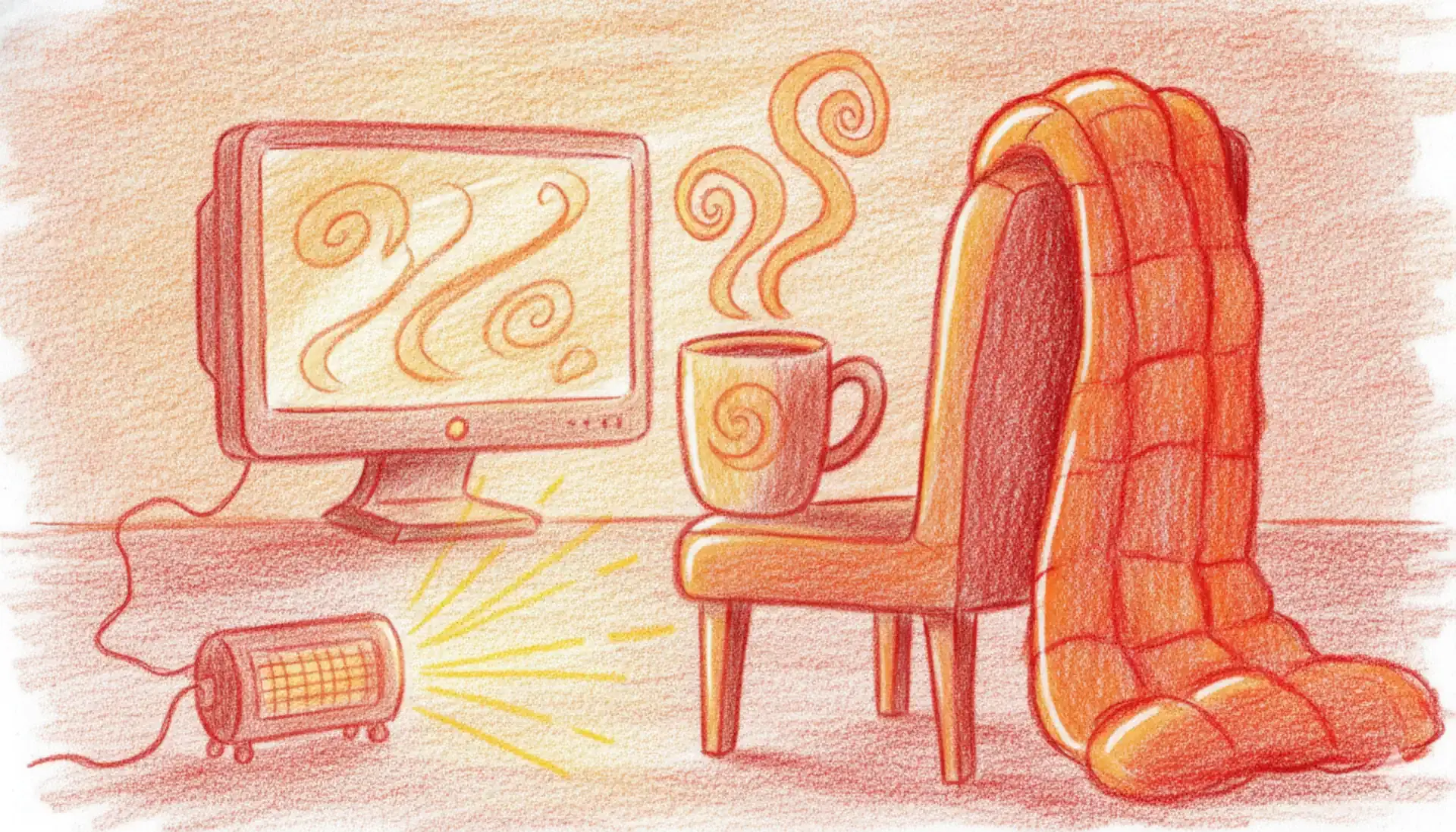
A foot heater under the desk, a blanket over the legs, slippers on the feet. These are not luxuries. They remove the friction of ambient discomfort. When the temperature is right and your body is comfortable, the mind stays locked in. One developer I know keeps an ottoman under his desk so he can sit with his legs fully extended. Another keeps a weighted blanket draped over his chair at all times. These small adjustments compound over an eight-hour session. They are the difference between finishing the day with energy and finishing it exhausted.
Rituals matter just as much as hardware. The three-drink setup is not about hydration. It is a pattern. Coffee on the left, tea in the middle, seltzer on the right. The brain learns this arrangement and associates it with coding mode. The same applies to music. Looping ambient tracks during deep focus. Switching to high-energy instrumentals during grunt work. Playing one song on repeat for hours. These are not preferences. They are environmental anchors that tell your brain it is time to work.
Rituals work because they remove decisions. You do not spend mental energy on what to drink or what to play. You just sit down and the cues are already there. Starting is the hardest part of any coding session. A good ritual makes the start automatic.
The environment around you matters more than any single tool you use. Open offices are the enemy of warm starts. Noise, interruptions, exposed screens. Every notification is a cold restart. You lose context and have to rebuild it from scratch. The most productive developers I have observed either work in private spaces or have mastered the art of the deep focus block. They close the door, put on headphones, and disappear for hours at a time.
Lighting is another factor that does not get enough attention. Fluorescent lights cause physical strain for many people. Headaches, eye fatigue, that drained feeling by mid-afternoon. Control over your lighting is not a perk. It is a productivity requirement. Developers who can dim the lights, use warm lamps, or work near natural light consistently report better focus. The same goes for noise control and temperature. These are not soft factors. They are hard constraints on cognitive performance.
None of this requires expensive gear. It requires intentionality. Your workspace is infrastructure, and you should treat it like you treat your codebase. Remove friction. Standardize the rituals. Control the environment. Invest in the conditions that let your brain run at its best.
A warm start beats a cold start every time. Take the time to warm up properly. Your code will thank you.
Disclaimer: All content reflects my personal views only and does not represent the positions, strategies, or opinions of any entity I am or have been associated with.