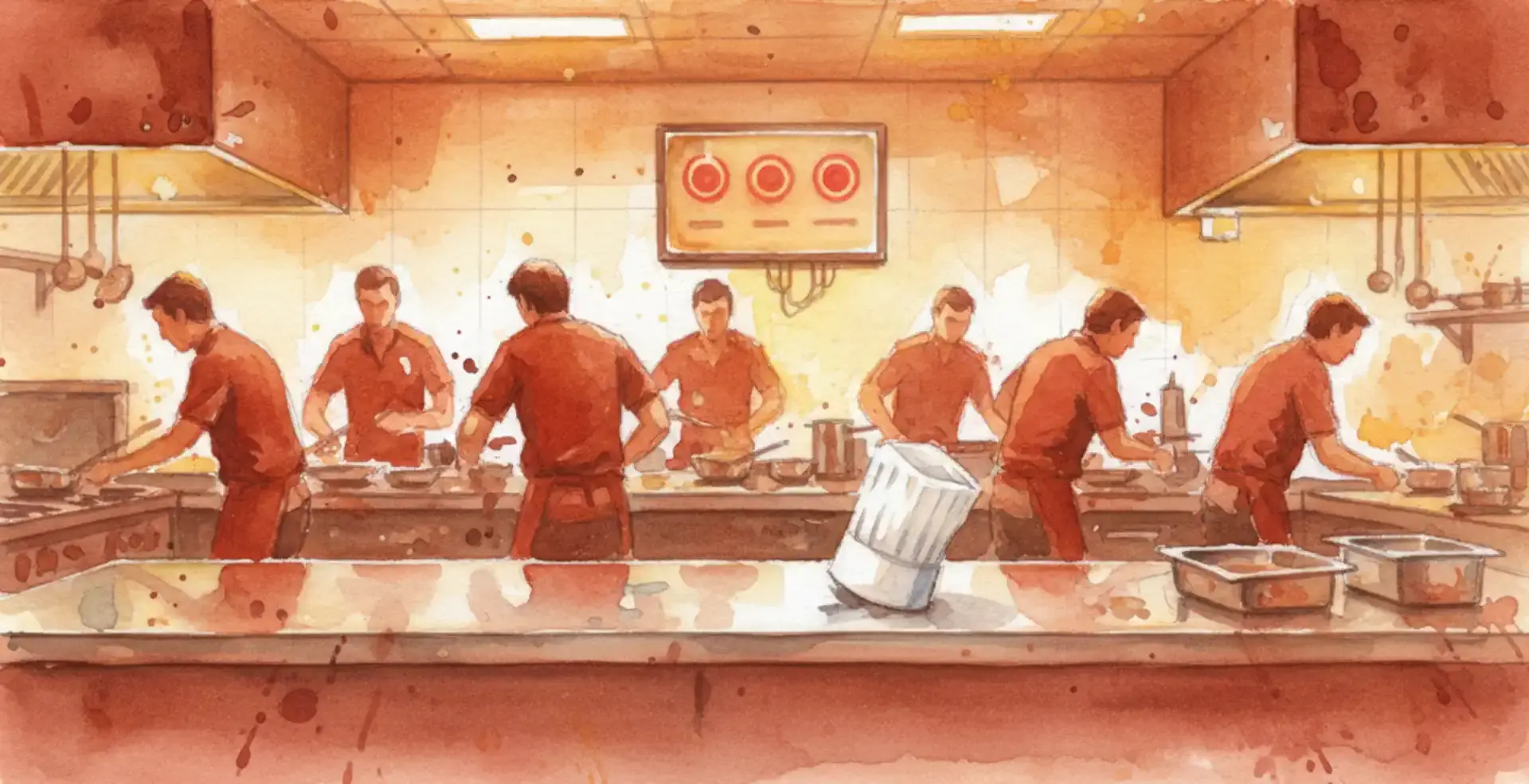
Undressed at Runtime: The Netflix Concurrency Bug That Passed Every Test

I started my career writing PHP. A few years later, I landed in C# and stayed there a long time. Then came Node, TypeScript, Python, and eventually a mix of everything. The one thing that followed me across every stack was this: the bugs that scare me most are not the ones that throw errors. They are the ones that compile, pass every test, and still break silently in production.
Netflix just showed the world exactly that kind of bug.
At a conference earlier this year, Paul Baker, an engineer on the Netflix Java platform team, walked through how they adopted virtual threads and structured concurrency across thousands of Spring Boot microservices. What his team discovered during that rollout is the kind of thing that makes you stare at your screen at 2 AM wondering how anything ever worked.
Here is the high-level problem. Structured concurrency lets you split work across multiple virtual threads, running tasks in parallel with a clean, modern API. It compiles. It passes your unit tests. But when those new threads spin up, they arrive empty. Your security context, who is making the request, stays behind. Your database transaction disappears. Your tracing information, the breadcrumbs you need to debug a failure, never makes the jump. All of it gets left behind the moment the thread forks.
Your code is correct. Your logic is sound. But the invisible scaffolding that frameworks quietly build around every single request simply does not carry over into the new thread. Your REST calls fail because there is no authenticated user. You cannot debug them because the traces were never passed along. And none of this shows up in your test suite because tests rarely simulate the full contextual weight of a real production request hitting a real cluster under real load.
Netflix discovered this the hard way. They had already tried rolling out virtual threads once before and hit a different problem, where certain language features locked virtual threads in place and caused cascading deadlocks. The latest Java release fixes that. But this second problem, the missing context, is far more dangerous because nothing crashes. Nothing throws an exception. It just quietly produces broken results in production, under real traffic, with real users paying the price.
Baker admitted there is no clean, universal fix for this yet. The frameworks that power the Java ecosystem were all built on an assumption that does not hold in the new concurrency model. Rewriting every one of them to handle context propagation properly would mean touching every layer of the stack. His team found a practical workaround, a way to manually bridge the gap when threads fork, but it is a stopgap, not the final answer. The real solution will take years.
What makes this story stick with me is not the Java specifics. It is the larger reminder that the fundamentals do not care what language you write. I have seen the same category of problem in PHP session handling, in C# async context flows, in Node's event loop pitfalls. The syntax changes. The underlying trap does not. Context propagation across asynchronous boundaries is hard everywhere. The engineers who ship reliable systems are the ones who understand what their runtime is actually doing beneath the surface, not just what the method signature promises.
Netflix runs over three thousand Java applications. Baker's team is one of the most sophisticated platform teams in the world. They are using AI to drive large-scale framework migrations, running language models as headless batch jobs that handle edge cases deterministic tooling could not. They embed AI agent workflows directly inside production microservices, multi-step chains where the engineer defines the steps and the model fills in the intelligent pieces between them. Java is not dead. It is not even resting. It is where some of the most challenging engineering problems on the planet are being solved right now.
If you are a polyglot engineer like me, someone who has moved across languages and frameworks and learned to trust no single ecosystem completely, the takeaway is simple. The next time a runtime or framework promises to handle concurrency for you, ask what travels with the request and what gets silently left behind. Because the bugs that compile are the ones that find you at 2 AM.
Disclaimer: All content reflects my personal views only and does not represent the positions, strategies, or opinions of any entity I am or have been associated with.